On the internet, there is a lot of information about Sushi that isn’t necessarily correct. For example, Sashimi is not Sushi. So, here is a map of the different types of Sushi.

The name Sushi comes from the word su meshi. Su means vinegar, and meshi means rice. Su meshi therefore means “vinegared rice.” This means Sushi doesn’t necessarily have to contain fish — there are kinds made with cucumber, pickled Daikon radish, or egg as well.
The origin of Sushi can be traced back to Southeast Asia, where it evolved into Nare Zushi in the Kansai region of Japan. Nare Zushi is made by pressing steamed rice into a box and topping it with slices of mackerel or other white fish. After being left to ferment for a while, the rice becomes sour, giving the dish its distinctive flavor. Later, this type of Sushi was introduced to Edo (known today as Tokyo).
People in Edo were impatient, so instead of waiting for the rice to ferment, they mixed it with vinegar. Sushi was sold as fast food at stalls in front of fish markets, made with freshly caught fish from Edo Bay. This style became known as Edo-mae Sushi.
Back then, there were no refrigerators, and without them, the fatty part of tuna didn’t last long — so it was often thrown away. Today, that same fatty tuna (Otoro) is considered a delicacy and is highly prized.
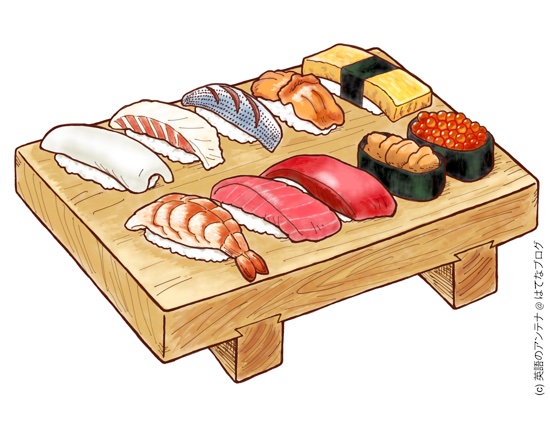
Salmon was not originally used for Sushi. Salmon in Japan was mainly caught in rivers, and freshwater fish often carry parasites, so it had to be cooked. In the mid-1980s, Norwegian salespeople introduced farm-raised, parasite-free salmon to Japan and used it to make Sushi. As a result, sales of Norwegian salmon increased dramatically. Today, salmon Sushi is one of the most popular types in Japan.
A Japanese Sushi chef who introduced Sushi to the United States thought that Nori (seaweed) wouldn’t appeal to American customers. So he came up with the idea of rolling the Nori inside the rice, hiding it from view (the inside-out roll). The Sushi rolls wrapped with salmon, avocado, or fish roe became popular. These are considered “American-style sushi,” though they are now also served at some conveyor-belt restaurants (Kaiten Zushi) in Japan.
Onigiri (rice balls) and Sashimi are not Sushi. Onigiri is made with plain rice, not vinegared rice, and Sashimi doesn’t include rice at all.